
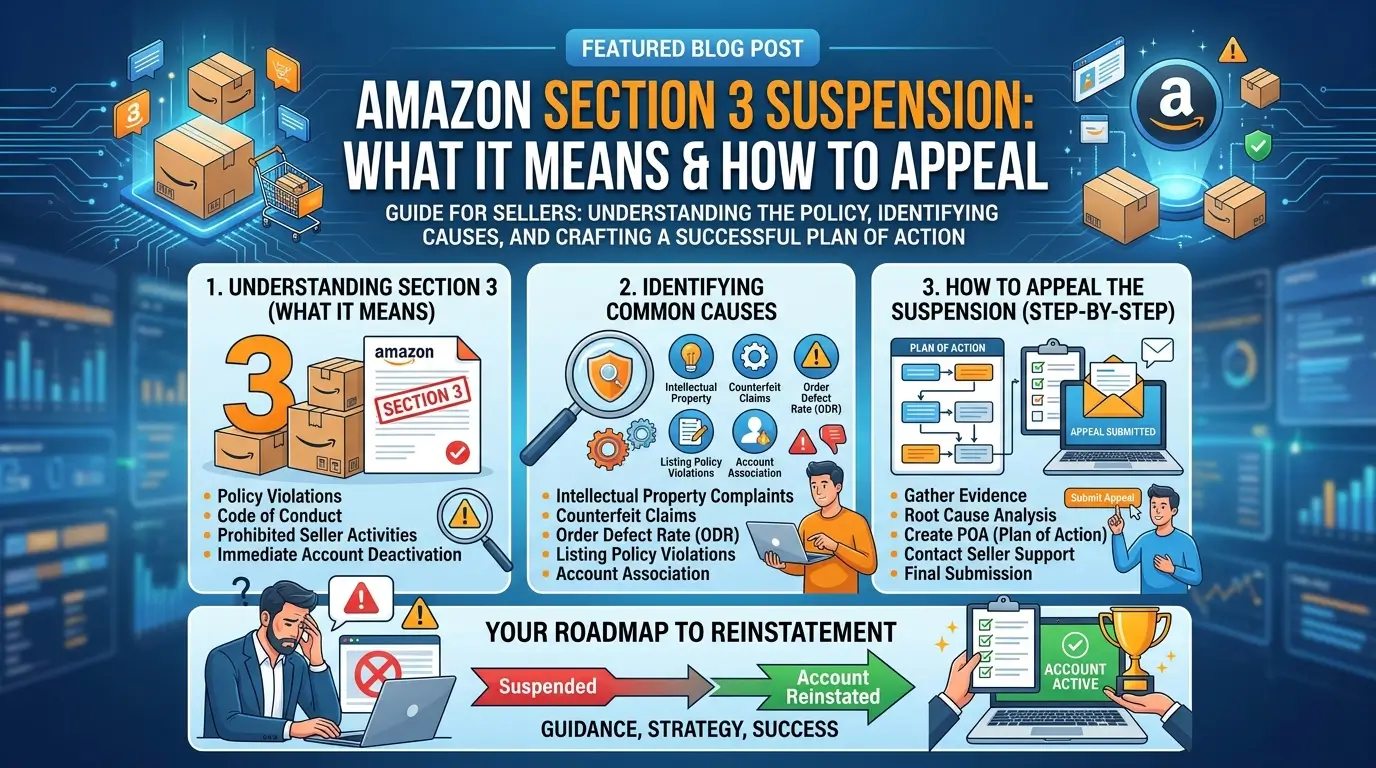
Amazon Section 3 Suspension: What It Means and How to Appeal (2026)
If you have received a notice saying your account was deactivated in accordance with Section 3 of the Business Solutions Agreement, you have probably already noticed it feels different from a normal suspension. There is no order defect rate mentioned, no single ASIN called out, and sometimes barely a reason given at all, just a reference to a section of a contract most sellers have never actually read. That vagueness is not a glitch. Section 3 is Amazon’s broadest enforcement tool, and understanding exactly what it means, and what Amazon is quietly asking for in return, is the difference between a fast reinstatement and a case that drags on for months.
Section 3 refers to the Term and Termination clause of Amazon’s Business Solutions Agreement, the part of the seller contract that gives Amazon broad discretion to suspend, withhold, or permanently close an account, often without disclosing a specific reason. Amazon typically invokes it for identity or business verification failures, suspected connections to another suspended account, severe or repeated intellectual property and authenticity violations, or suspected fraud. Appealing successfully starts with figuring out which of these categories actually applies to your account, since the notice rarely spells it out, then building a plan of action and supporting documents around that specific category instead of a generic response.
What Section 3 of the Agreement Actually Says
Every seller agrees to Amazon’s Business Solutions Agreement when opening an account, whether they read it closely or not. Section 3 of that agreement covers term and termination, the part that spells out Amazon’s right to suspend, withhold payments from, or permanently close a seller account at its own discretion. It is written broadly on purpose, and it does not require Amazon to prove a violation beyond a reasonable suspicion, or to disclose every detail behind its decision, since Amazon treats parts of its enforcement process as confidential for security and competitive reasons.
Most suspensions sellers deal with reference a specific, narrower policy, something tied to a measurable metric like order defect rate, or a specific complaint about a specific ASIN. Section 3 sits above that layer. It is the clause Amazon reaches for when it wants to act on the entire account rather than a single listing, usually because it suspects a pattern of behavior rather than one isolated mistake.
How This Differs From a Normal Suspension
| Aspect | Standard policy suspension | Section 3 suspension |
|---|---|---|
| Scope | Usually one ASIN, listing, or account health metric | The entire seller account |
| Notice detail | Names a specific policy, often with affected orders or ASINs | Often vague, sometimes with no specific detail at all |
| Funds | Held on Amazon’s standard reserve schedule | Often held well beyond the standard schedule while the case is investigated |
| Path back | Usually one well targeted plan of action | May require a plan of action plus identity or video verification, sometimes across several rounds |
| Typical cause | A single performance metric or policy issue | Identity verification, related accounts, repeated violations, or suspected fraud |
The Most Common Reasons Amazon Uses Section 3
Because the notice itself is often vague, the fastest way to move forward is to work through this list honestly and figure out which one plausibly applies to your account.
- Identity or business verification failures. Mismatches between your registered name, address, or bank statement and the information Amazon has on file, a failed initial verification, a failed annual reverification, or documents that appear inconsistent or altered.
- Suspected related or linked accounts. Amazon’s systems track shared identifiers such as IP address, device, payment method, business address, supplier, or prep center. If any of those overlap with another account that was previously suspended, it can trigger a Section 3 action even if you were not aware of the connection.
- Severe or repeated intellectual property and authenticity issues. Multiple counterfeit or inauthentic complaints, especially if they continue after a prior warning or a rejected appeal.
- Suspected fraud or deceptive activity. This can include fake reviews, manipulated sales rank, coordinated ordering patterns, chargeback abuse, or documents submitted during an earlier appeal that Amazon believes were falsified.
- Extreme or compounding policy violations. A pattern of separate issues across different parts of the account, rather than one isolated metric, can push Amazon toward account level action instead of a listing level one.
What Happens to Your Account After the Suspension
A Section 3 suspension deactivates the entire seller account rather than a single listing. Active offers come down across the board, and FBA inventory is typically frozen in place, meaning it is neither sellable nor immediately available for removal while the review is underway. Funds are commonly held well beyond Amazon’s standard reserve period, and the length of that hold is tied to how long the investigation takes rather than a fixed date on the calendar, which is part of why these cases feel so open ended. In many cases, Amazon will also request a video verification call before it will seriously consider a written appeal, particularly when the suspected issue involves identity, business legitimacy, or supply chain authenticity.
The Video Verification Call, What to Expect
A growing share of Section 3 cases now include a live video verification call, sometimes scheduled with very short notice. A representative reviews your identity and business documents in real time and may ask questions about your supply chain, your suppliers, and how specific inventory was sourced.
Commonly requested documents include a valid government issued photo ID, a bank or credit card statement that is usually less than 180 days old and shows your name or business name along with your address, business registration documents, and in some cases supplier invoices tied to specific ASINs under review.
- Use original, unedited documents. Any sign that a document has been cropped, altered, or edited, even for an unrelated reason, can escalate the case rather than help it.
- Have both printed and digital copies ready before the call so you are not searching for a file while a representative is waiting.
- Take the call somewhere quiet and well lit, and keep your camera steady and clearly focused on both you and any documents you present.
- Answer directly. If you genuinely do not know an answer, say so rather than guessing, since hesitant or inconsistent answers are commonly cited as a reason calls do not go well.
- Be ready to explain your supply chain in plain terms: who you buy from, how you verify them, and how you can prove it.
How to Appeal a Section 3 Suspension, Step by Step
- Read the notice slowly for every available clue. Section 3 notices are vague, but they are rarely completely silent. Words like related account, documents, authenticity, or business information are hints about which category applies, even when no specific ASIN or order is named.
- Audit the entire account, not just the obvious issue. Check Account Health for any other outstanding flags, review recent verification requests, consider whether any other account might share your home address, device, payment method, or supplier, and review any policy warnings from the past several months. Section 3 often builds on something that was already flagged once before.
- Identify the specific underlying category before writing anything. Your plan needs to target the actual cause, not a general restatement of “Section 3,” so this diagnosis step is not optional.
- Gather documentation in advance. Identity documents, business registration, banking statements, supplier invoices and communication, and if a related account is suspected, evidence showing genuine separation between accounts.
- Write the plan of action using the same core structure that works for any Amazon appeal. A specific root cause, corrective actions you have already completed with dates, and preventive measures that are documented and owned. For Section 3, the root cause section often needs to directly address why the account is legitimate and independent, not only explain a single mistake.
- Submit through Seller Central and prepare for a video verification request. Treat it as a normal part of the process for this category rather than a sign that something has gone wrong.
- If the appeal is rejected, read the response for any new detail and address that specific gap. Resubmitting the same explanation without changes rarely produces a different result, and can make the case look less credible rather than more.
Because Section 3 cases often turn on subtle verification or documentation details rather than one clear policy violation, this is one of the categories where sellers most often bring in dedicated help. Our Amazon Section 3 suspension appeal service is built specifically around this category, from auditing the account for hidden triggers to preparing sellers for the video verification call.
If You Suspect a Related Account Issue
Related or linked account suspicion is one of the most confusing versions of a Section 3 case, because the connection is not always something a seller is even aware of. Amazon’s systems watch for overlap across several identifiers: IP address, device fingerprint, payment method, business address, supplier, prep center, and the government ID used at signup. If any of those overlap with an account that was previously suspended or banned, it can be enough to trigger enforcement on a brand new, otherwise clean account.
These connections are often entirely innocent. A spouse or former business partner who previously ran a separate account, a shared office or coworking space that assigns the same public IP address to multiple businesses, or a virtual assistant or agency logging into several clients’ Seller Central accounts from the same device can all create an overlap that looks suspicious to an automated system even though nothing improper occurred.
To demonstrate genuine separation, focus on documenting independent business registration and banking, a clear written explanation of any legitimate relationship involved (such as a former partner or shared service provider), and evidence of when and how any shared connection ended. Going forward, keeping separate devices, networks, and payment methods for any additional accounts materially reduces the chance of this happening again. This scenario is common enough that we cover it in more depth in our guide to related and linked account suspensions, including how Amazon detects these connections and how to prove your accounts are genuinely independent.
Mistakes That Make a Section 3 Case Worse
| Mistake | Why it backfires |
|---|---|
| Opening a new seller account while the original is suspended | Amazon treats this as evidence of exactly the kind of related account activity Section 3 exists to catch, and it can lead to both accounts being closed permanently |
| Submitting a generic plan of action | Section 3 causes vary enormously, and a generic response signals that the real issue was never actually diagnosed |
| Arguing about fairness or citing years selling on Amazon | None of that answers the verification or trust question Amazon is actually asking |
| Sending altered or edited documents | Any sign of manipulation, even minor cropping done for an unrelated reason, can escalate rather than resolve the case |
| Guessing the wrong category | Addressing an authenticity concern when the real issue is business verification, or the reverse, wastes an entire appeal cycle |
| Ignoring or delaying a video verification request | Missing or postponing this step commonly stalls reinstatement indefinitely |
How Long Reinstatement Usually Takes
There is no fixed timeline, and it is worth setting expectations honestly rather than promising a specific number of days. Straightforward verification mismatches sometimes resolve within a couple of weeks. Cases involving suspected related accounts or serious intellectual property concerns often take considerably longer, sometimes several months, particularly if more than one round of appeal or verification is needed. A smaller number of cases are never reinstated, generally where Amazon’s investigation concludes there was genuine fraud or repeated deliberate deception. Patience matters here, but so does momentum. Long gaps between a rejection and a stronger, better documented resubmission tend to work against you.
Final Checklist Before You Respond
- Read the full notice slowly for every available clue about the underlying category
- Audit the entire account rather than assuming you already know the cause
- Identify the specific category, verification, related account, authenticity, or fraud, before writing anything
- Gather identity, business, and supplier documentation in advance
- Prepare thoroughly for a possible video verification call
- Write a plan of action that names a specific root cause, not just the word “Section 3”
- Avoid opening any new seller account while this one is under review
- Avoid resubmitting identical text if the first appeal comes back rejected
Frequently Asked Questions
Can Amazon suspend an account under Section 3 without giving a specific reason?
Yes. The clause gives Amazon broad discretion, and notices often reference only Section 3 or general language about suspected fraudulent or deceptive activity without naming a specific ASIN or policy. Asking Amazon repeatedly for more detail rarely changes this, so the more productive step is auditing your own account for what could plausibly apply.
Will opening a new seller account help while this one is suspended?
No, and it is one of the most damaging mistakes a seller can make. Amazon’s systems are specifically built to detect new accounts connected to a suspended one, and doing this during an active investigation is commonly treated as evidence of the exact related account activity Section 3 exists to catch.
How long are funds held during a Section 3 suspension?
There is no fixed period. Holds commonly extend well beyond Amazon’s standard reserve schedule since the length is tied to the investigation rather than a set date, and sellers have reported holds ranging from several weeks to several months depending on the case.
What happens if I fail the video verification call?
A failed or incomplete verification does not necessarily end the case, but it typically extends it and may lead to additional information requests. Preparing thoroughly beforehand matters, since going in unprepared or presenting documents that look inconsistent is one of the more common reasons a call does not go well.
Is a Section 3 suspension permanent?
Not always. Many sellers are reinstated, particularly when the underlying issue is a verification mismatch or a related account that can be clearly explained and documented. Reinstatement becomes far less likely when Amazon’s investigation concludes there was genuine fraud, deception, or repeated serious violations.
Should I hire a lawyer or a reinstatement service for a Section 3 case?
It depends on the complexity of the case. Straightforward verification mismatches are sometimes resolved by a well prepared seller working alone. Cases involving suspected related accounts, serious intellectual property allegations, or a first appeal that has already been rejected tend to benefit from experienced help, since these cases often turn on details, like which document to submit or how to frame an explanation, that are easy to get wrong on a first attempt.
A Section 3 suspension is one of the more serious actions Amazon can take against an account, but it is not automatically hopeless. The sellers who get reinstated fastest are the ones who resist the urge to react immediately, take the time to correctly diagnose which category actually applies to their case, and respond with specific documentation rather than a generic explanation. Treat the process methodically, and prepare for the possibility of a video verification call rather than being caught off guard by one.


Add comment