
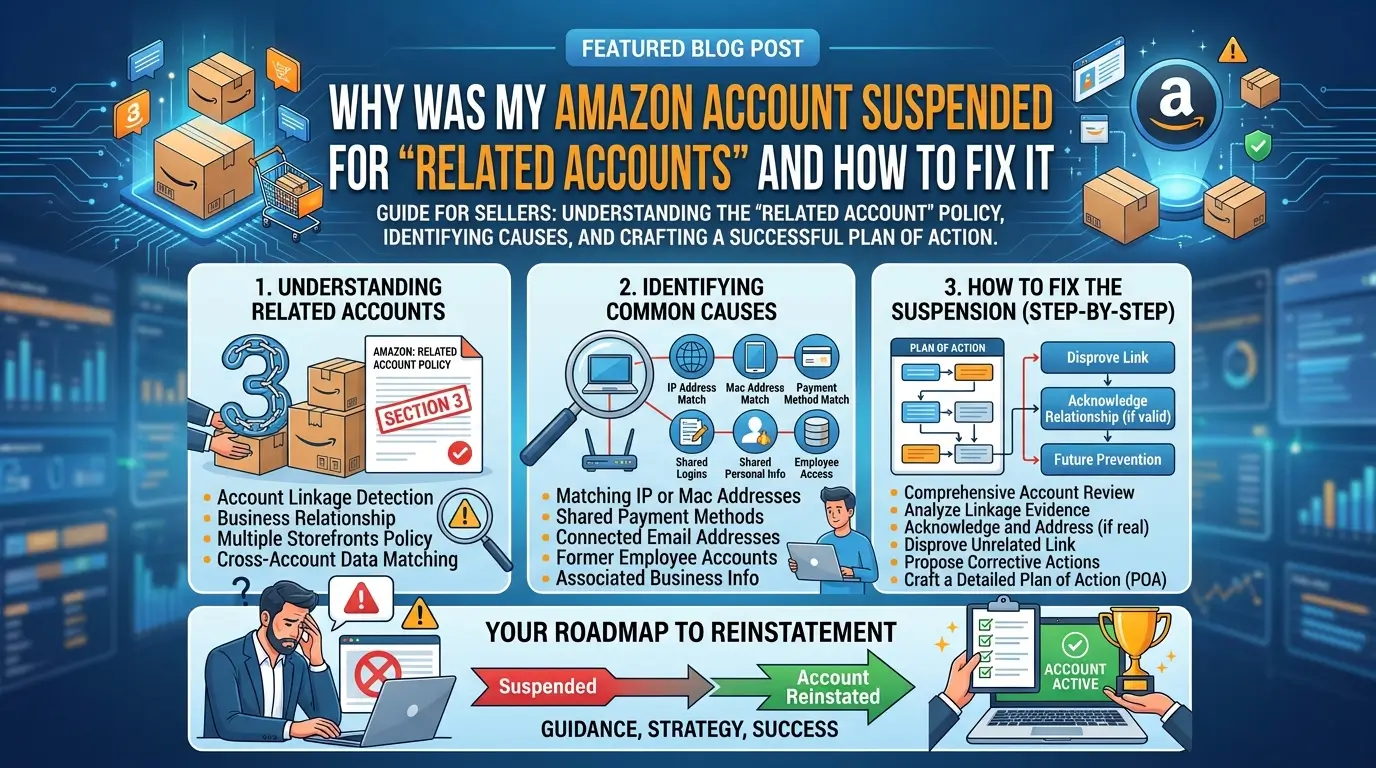
Why Was My Amazon Account Suspended for “Related Accounts” and How to Fix It
Few Amazon suspension notices cause as much confusion as the one that says your account has been deactivated for being related to another account. Many sellers read that message and have no idea which account Amazon even means. Some have never knowingly opened a second seller account in their life. Others know exactly which account it refers to and assumed the connection stopped mattering years ago. Either way, the instinct that follows is almost always the same, and almost always the wrong one: open a brand new account and try to start over. This guide explains what a related account suspension actually means, how Amazon detects these connections, and the specific appeal approach that works, because the right fix depends entirely on which of three situations you are actually in.
A related account suspension means Amazon’s systems detected an overlap, in things like device, IP address, payment method, business address, phone number, or tax information, between your account and another Amazon seller account, often one that was previously suspended. Amazon generally allows only one seller account per person or business without an approved exception, so any detected connection can trigger enforcement on both accounts. Fixing it starts with honestly identifying which of three situations applies to you: the connection is a false positive, a real connection that has since genuinely ended, or a real and current connection, since each one calls for a completely different appeal.
What a Related Accounts Suspension Actually Means
Amazon’s seller policies generally allow one selling account per person or business entity, unless a seller has a specific, approved business reason for operating more than one. When Amazon’s systems detect a meaningful overlap between two accounts, whether that overlap is in ownership, devices, payment details, or a handful of other identifying signals, it treats both accounts as connected and can suspend either or both, regardless of whether the account in question has an otherwise clean history.
This is one of the more disorienting suspension types because the account you get flagged for connecting to is not always one you actively use, or even one you remember. It might belong to a former business partner, an employee who has since left, or simply share a wifi network you used once at a coworking space. Related account suspensions are commonly issued under the same broad discretion Amazon uses for its most serious enforcement actions. If your notice also references Section 3 of the Business Solutions Agreement, our guide to Section 3 suspensions explains that broader clause and what else it can cover.
How Amazon Actually Detects Related Accounts
Amazon does not rely on a single data point. Sellers and consultants who have worked through these cases consistently report that Amazon’s systems cross reference a long list of identifiers, reportedly more than twenty in total, to decide whether two accounts are connected. The most commonly cited factors include the following.
- Device and browser fingerprints, including the specific computer or phone used to log in
- IP address, particularly repeated access from the same network
- Payment methods, including bank account and credit card details
- Business address, both the registered legal address and the operating or shipping address
- Phone number and email address used on the account
- Tax identification information, such as an EIN or equivalent
- Supplier information, prep centers, and details that appear on packing slips or invoices
- Shared login credentials, even if used only once
A single overlapping data point does not always trigger a suspension on its own, but several overlapping at once, especially payment method combined with device or address, is a strong enough pattern for Amazon’s systems to act on.
The Three Types of Related Account Suspensions
Before you write a single word of an appeal, it is worth being completely honest with yourself about which of these three situations actually applies. Each one needs a different appeal, and misdiagnosing which one you are in is the single most common reason these appeals fail.
Type one: a false positive, no real relationship exists
Amazon’s automated systems flagged a connection that does not reflect any actual relationship between the accounts. Common causes include logging in from a hotel, coworking space, or shared office network that assigns the same public IP address to unrelated businesses, an agency or virtual assistant who manages multiple unrelated clients’ accounts from the same device, or a coincidental overlap in personal details, such as a common last name and city, with a stranger’s account.
Type two: a real relationship that has genuinely ended
There was an actual connection at some point, but it has since ended in a documentable way. This covers situations like selling a business to a new owner, a former business partner who has since fully separated from the company, or an employee with prior account access who is no longer with the business.
Type three: a real and current relationship
You currently own, control, or have meaningful involvement in both accounts. This is the hardest situation to resolve, because you cannot argue the accounts are unrelated when they are not. The available paths here are requesting Amazon’s approval for a legitimate business need to operate more than one account, which requires a specific and well documented justification, or resolving the situation by closing or consolidating one of the accounts rather than continuing to operate both without approval.
What Amazon Will and Will Not Tell You
The initial suspension notice is almost always vague, sometimes naming no other account at all. It is worth knowing that Amazon does sometimes share a little more detail once a seller has submitted a serious, well documented appeal and followed up politely through Account Health support, though this is not guaranteed and varies case by case. In some instances, sellers have been given a partial identifier, such as the last few characters of the related account’s name, the general category of the connection (for example, a note that it relates to financial information or an address), or the approximate date the connection was detected. This information, when available, can be genuinely useful for narrowing down which of the three situations above actually applies to your case, so it is worth asking for calmly and specifically rather than assuming Amazon will volunteer it upfront.
How to Appeal, Depending on Your Situation
If it looks like a false positive
- Review your own login history, network usage, and any shared devices to identify the most likely source of the overlap.
- Gather documentation that demonstrates your account’s independence: business registration, unique banking details, and a specific explanation for the overlap Amazon likely detected, such as a signed agreement with a virtual assistant or agency, or proof of a shared coworking space.
- If an agency or VA is involved, include a signed service agreement or contract showing they were retained specifically for your business and explain that they may work with other unrelated sellers as well.
- State clearly, with evidence, why the detected overlap does not reflect an actual business relationship, rather than simply asserting that the suspension is a mistake.
If a real relationship has ended
- Gather proof of the relationship’s end: a signed sale agreement if you purchased or sold a business, a dissolution or partnership exit document, or an employment termination letter and date.
- Show that all connecting information has since been separated, including devices, networks, payment methods, and login credentials.
- Be specific about dates. Amazon wants to see exactly when the connection ended, not a general statement that it is “no longer relevant.”
If the relationship is real and current
- Do not attempt to argue the accounts are unrelated when they are not, since this is one of the fastest ways to lose credibility with a reviewer who already has the connecting data in front of them.
- Consider whether your situation meets Amazon’s bar for a legitimate business need to run more than one account, such as operating genuinely distinct brands under separate legal entities, and prepare a specific, well documented justification if so.
- If a legitimate business need does not clearly apply, the more realistic path is usually to consolidate operations under a single account or formally close one, rather than continuing to operate both without approval.
Writing the Plan of Action
A related account plan of action follows the same underlying structure as any Amazon appeal, adapted to this specific situation. The root cause section should name the specific connection you believe Amazon detected, based on your own review, rather than a vague statement that you “may be linked to another account.” The corrective actions section should describe, in the past tense with dates, exactly what has already been separated or resolved, such as closing shared access, updating payment methods, or providing termination or sale documentation. The preventive measures section should describe the ongoing practices now in place to keep the accounts separate going forward, such as dedicated devices and networks for each account, unique payment methods, and, if relevant, a documented internal policy for how an agency or team manages access across multiple clients.
What Not to Do
| Mistake | Why it backfires |
|---|---|
| Opening a new seller account after the suspension | Amazon’s systems typically detect the new account as connected almost immediately, often resulting in both accounts being suspended and making reinstatement significantly harder |
| Denying a relationship that is actually current | Reviewers already have the connecting data, so denying an accurate connection reads as dishonest rather than persuasive |
| Submitting a vague appeal that never names a likely connection | A generic statement that the accounts are unrelated does not give Amazon anything specific to evaluate |
| Resubmitting the same appeal repeatedly without new evidence | Identical resubmissions rarely produce a different outcome and can make the case look weaker over time |
| Relying on VPNs or identity masking tools to avoid detection | These tools do not resolve the underlying connection and can make an account look deliberately evasive if discovered |
How to Prevent This in the Future
- Use a dedicated device and a separate, non shared network for each Amazon seller account you operate
- Keep payment methods, business registration, tax information, and phone numbers unique to each account
- Put agency and virtual assistant relationships in writing, including which accounts they are authorized to access
- Document the sale, purchase, or transfer of any Amazon business properly, including a clear handoff of all account credentials and connected information
- Set up new accounts for international marketplaces correctly from the start, following Amazon’s specific requirements for multi region selling
- Periodically review who has access to your account and remove access promptly when a relationship ends
Final Checklist Before You Appeal
- Honestly identify which of the three situations, false positive, ended relationship, or current relationship, applies to you
- Review your own login history, devices, and shared information for the likely source of the connection
- Gather documentation specific to your situation: business records, termination or sale documents, or proof of independence
- Name the likely connection specifically in your appeal rather than making a general denial
- Avoid opening any new seller account while the suspended one is under review
- Politely request additional detail from Account Health support if your first appeal does not move forward
Frequently Asked Questions
Can I open a new account if my related account was suspended?
No. Amazon’s systems are specifically designed to catch this, and a new account opened while the original is under review is commonly detected and suspended quickly, which typically makes reinstating the original account harder rather than easier.
What if I do not recognize the account Amazon says I am linked to?
This is common, especially with false positive cases involving shared networks or coincidental personal details. Focus your appeal on documenting your own account’s independence and requesting, politely and through Account Health support, any additional detail Amazon can share about the nature of the connection.
Can I legally run two Amazon seller accounts?
Only with Amazon’s approval for a specific, legitimate business need, such as operating genuinely distinct brands under separate legal entities. Running two accounts without that approval, even if both are otherwise compliant, can lead to both being suspended once a connection is detected.
How long does a related account appeal take?
It varies considerably depending on which of the three situations applies and how quickly you can produce clear documentation. False positive cases with strong evidence sometimes resolve in a few weeks. Cases involving a real, current relationship or requiring a legitimate business need review tend to take longer.
Will Amazon tell me which account I am linked to?
Not always, and rarely in the initial notice. With a detailed, well supported appeal and polite follow up through Account Health support, Amazon sometimes shares a partial identifier or general category for the connection, though this is not guaranteed in every case.
Should I get professional help with a related account suspension?
It depends on how clear your situation is. A straightforward false positive with strong documentation is sometimes resolved by a seller working alone. Cases involving a past business relationship, a legitimate business need request, or a first appeal that has already been rejected often benefit from experienced help, since correctly diagnosing the connection is the part sellers most often get wrong.
A related account suspension is confusing precisely because the connection is not always something you were aware of, and the instinct to simply start fresh with a new account almost always makes things worse. The sellers who resolve these cases fastest are the ones who take the time to honestly work out which of the three situations they are actually in, and build their appeal around specific, documented facts rather than a general denial. If you would rather have this diagnosed and handled directly, our related and linked account suspension appeal service is built specifically around identifying the connection and preparing the right kind of evidence for your situation.


Add comment