
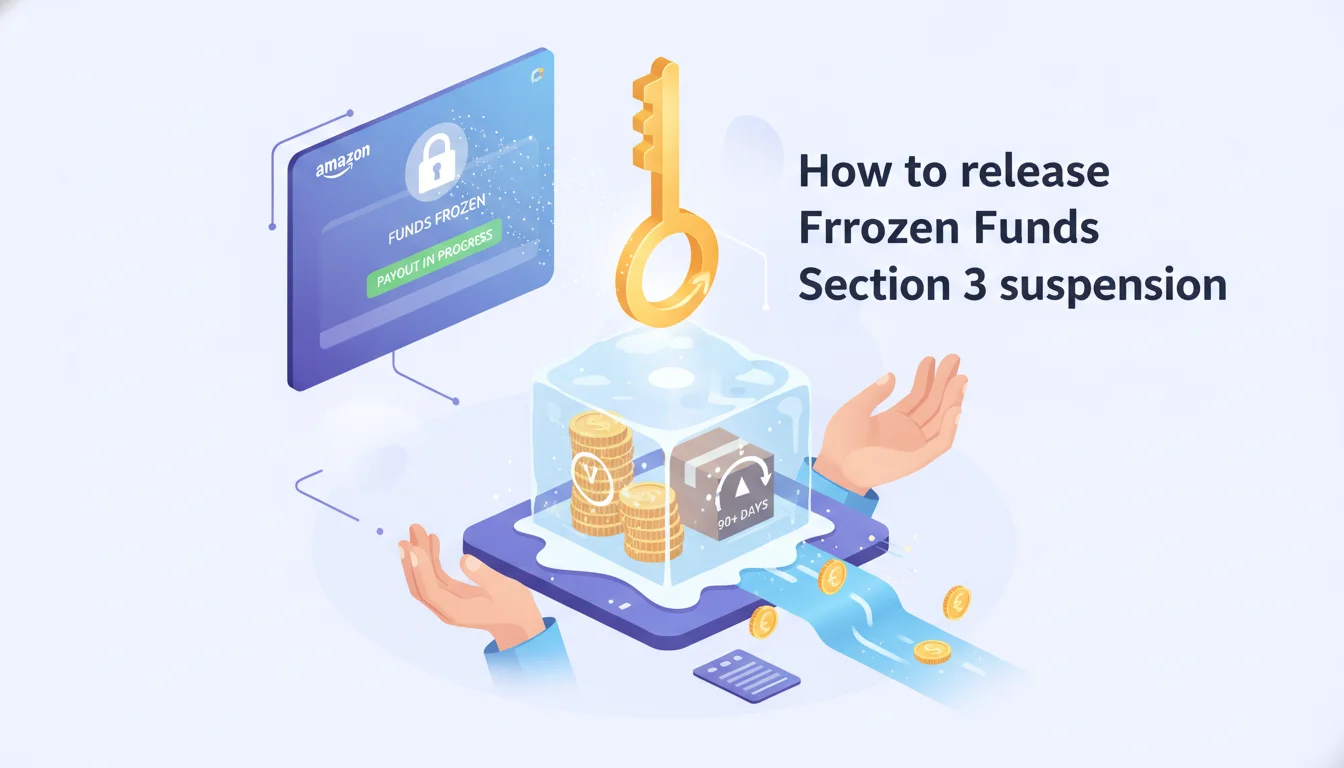
How to Release Frozen Funds After an Amazon Section 3 Suspension (Step-by-Step Recovery Guide)
Waking up to an Amazon account deactivation notice is devastating. But discovering that tens or hundreds of thousands of dollars in operating capital are frozen indefinitely under Section 3 of the Amazon Services Business Solutions Agreement (BSA) is a catastrophic blow to any e-commerce business. Suddenly, payroll, supplier invoices, and inventory reorders come to a grinding halt.
By default, Amazon implements an automatic hold on balance disbursements following a Section 3 enforcement. Sellers are typically told to wait 90 days for a funds review. However, waiting passively for 90 days rarely yields an automatic payout. In reality, without a proactive, evidence-backed funds disbursement appeal, Amazon will often classify the account under “deceptive, fraudulent, or illegal activity” and withhold your balance permanently.
This comprehensive, semantic guide provides an actionable, end-to-end blueprint on how to release frozen funds following an Amazon Section 3 suspension. Whether your deactivation stemmed from drop shipping policy violations, inauthentic inventory claims, code of conduct breaches, or multiple account associations, this guide outlines the procedural steps, evidentiary standards, and legal escalations required to recover your withheld capital.
Understanding the Section 3 Funds Freeze: Why Amazon Holds Your Capital
To recover your funds, you must first understand the legal and operational mechanisms Amazon uses to justify withholding disbursements.
1. The Amazon Services Business Solutions Agreement (BSA) Clause
Section 3 of the BSA governs termination and suspension. It grants Amazon broad discretion to terminate merchant accounts immediately if they determine the seller has engaged in deceptive, fraudulent, or illegal activity, or has repeatedly violated platform policies. Crucially, the payment policy stipulations tied to Section 3 grant Amazon Payments, Inc. the right to retain funds to offset anticipated buyer claims, refunds, returns, chargebacks, and A-to-z Guarantee claims.
2. The Standard 90-Day Holding Period
Amazon enforces a minimum 90-day holding window from the deactivation date. This timeframe corresponds to the typical 90-day window during which buyers can file A-to-z Guarantee claims or return items. During this phase, Amazon’s automated algorithms calculate a rolling reserve, ensuring sufficient capital remains to indemnify the platform against buyer dissatisfaction or counterfeit liability.
3. The Permanent Retention Risk
If you fail to act after 90 days, or if your funds appeal is rejected, Amazon will issue the dreaded response: “We have completed our review of your account and determined that your balance will not be disbursed.” Under the BSA, Amazon claims the right to retain funds permanently if it believes releasing them facilitates fraudulent or counterfeit transactions. Recovering funds at this stage requires escalating beyond standard automated Seller Support queues.
Prerequisites: What You Must Gather Before Filing a Funds Appeal
Do not contact Amazon’s disbursement department until your evidentiary package is fully prepared. Incomplete or contradictory submissions trigger automated rejections that permanently close communication lines. Gather the following documentation:
- Complete Invoicing Trail: Invoices for the last 365 days of sales. Invoices must show valid supplier names, physical addresses, tax/EIN numbers, phone numbers, and official websites matching commercial registry databases.
- Proof of Supplier Authenticity: Supplier commercial registration, authorized brand distributor letters, or direct manufacturer authorization agreements (Letter of Authorization / LOA).
- Logistics and Fulfillment Documentation: Bills of Lading (BOL), freight forwarder receipts, tracking IDs with signature confirmation, and customs import entries (Form 7501 for US imports) proving goods were physically moved into commerce.
- Banking and Corporate Identity Verification: A recent (less than 90 days old) bank account statement with matching legal entity names and addresses, utility bills for the primary contact, business licenses, and government-issued photo IDs of all primary account managers.
- Customer Service Records: Evidence that all pending orders prior to suspension were fulfilled, tracking IDs were valid, and buyer inquiries were resolved with zero outstanding unfulfilled orders.
Step-by-Step Tutorial: How to Release Frozen Funds
Follow this exact chronological framework to request, verify, and disburse your frozen capital.
Step 1: Calculate the Exact 90-Day Eligibility Date
Do not submit a funds disbursement appeal before the 90-day window expires, unless you are actively appealing for full account reinstatement. If you submit a funds request on day 45, Amazon’s system will reject the ticket with a template response: “Your account was deactivated within the last 90 days.”
Log in to Seller Central, check the exact timestamp of your initial suspension notification under Performance Notifications, and mark Day 91 on your calendar. Your funds appeal should be submitted on or shortly after Day 91.
Step 2: Submit the Official Disbursement Appeal
Once the 90-day period lapses, direct your funds request to the specialized payment reviews team. Do not open standard Seller Support cases, as general tier-1 agents lack authorization to release reserve holds.
Send an email to [email protected] (or [email protected] / [email protected] depending on your marketplace jurisdiction) using your registered Seller Central primary email address.
Your email subject line must follow a standardized format:
Subject: Funds Disbursement Appeal – [Your Legal Business Name] – [Your Merchant Token / Seller ID] – Section 3 Review
Structure the body of the appeal concisely:
- Executive Summary: State your Merchant ID, registered account email, suspension date, and that more than 90 days have elapsed.
- Account Health Overview: Highlight that all customer orders were fulfilled, confirm an A-to-z claim rate of 0% (or current low rate), and prove zero pending buyer messages exist.
- Verification of Supply Chain: Summarize the legitimacy of your inventory sources and note that all supporting documentation is attached in clean PDF format.
- Formal Request: Request a Funds Disbursement Review and invite them to schedule a virtual identity verification interview if required.
Step 3: Complete the Funds Virtual Video Verification (VVV)
In over 80% of modern Section 3 disbursement cases, Amazon now mandates a Virtual Identity and Supply Chain Video Verification Interview before unlocking balances. This 20- to 45-minute video call is conducted with an Amazon risk and compliance investigator.
To pass this interview successfully:
- Have the Primary Account Owner Present: The individual whose passport/driver’s license is registered to the account must be on camera. If third-party consultants or employees speak on their behalf without prior authorization, Amazon will immediately terminate the call and fail the verification.
- Hard Copies Ready: Print out physical copies of your invoices, bank statements, supplier agreements, tax filings, and shipping records. Investigators will ask you to hold these documents up to the camera.
- Know Your Operations Intimately: Be prepared to answer granular questions about your supply chain: How did you find this supplier? What terms did you pay (Net 30, Wire, Credit Card)? Who packs and ships your items? What were your best-selling SKUs? Any hesitation or discrepancy creates suspicion of account brokering or fraud.
Step 4: Resolve Any Secondary Inquiries
Following the interview, Amazon typically takes 3 to 7 business days to process the verification. In some scenarios, the investigator will request additional documentation via a follow-up link within 24 hours. Submit all requested supplemental files immediately.
Step 5: Disbursement and Bank Verification
Upon approval, you will receive an email stating: “We have completed our review and will disburse your funds on the next scheduled settlement date.” Verify that the deposit method in Seller Central is active, valid, and registered under the same corporate name as the account to prevent last-minute banking rejections.
Troubleshooting Common Roadblocks & Rejections
The path to recovering locked funds is rarely linear. Here is how to navigate the most common obstacles sellers face during Section 3 disbursement appeals:
Issue 1: “We determined that your account has been used to engage in deceptive, fraudulent, or illegal activity.”
This is the most aggressive rejection. It indicates Amazon intends to invoke its right under Section 3 to permanently withhold your balance. This usually happens in cases involving drop shipping with fake tracking numbers, intellectual property infringement, or suspected forged invoices.
Remedy: You must complete an end-to-end Forensic Audit. Re-submit your appeal by identifying the exact root cause of the violation, demonstrating the genuine authenticity of your past transactions, and showing that no customers were financially harmed. If invoices were previously deemed invalid, obtain a notarized affidavit from your supplier confirming the transactions.
Issue 2: The Silent Wall (No Response After 14+ Days)
If [email protected] goes completely dark after multiple polite follow-ups spaced 5 days apart, your ticket has likely been routed into a dormant backlog.
Remedy: Escalate through alternative executive operational channels. Submit a concise escalation to the Executive Seller Relations team ([email protected] or [email protected]). Clearly indicate: “More than 120 days have passed since deactivation, all customers have been satisfied, and the disbursement team has failed to respond to Case ID [Number].”
Issue 3: Third-Party Dropshipping / Supply Chain Rejection
If your account was deactivated for Section 3 Drop Shipping policy violations, Amazon often assumes you used retail arbitrage or purchased items directly from another retailer (e.g., Walmart, Sam’s Club, Home Depot) without holding physical inventory.
Remedy: You must supply authentic delivery signatures, order confirmations, contracts with prep centers, or third-party logistics (3PL) agreements. If you operated an unauthorized retail arbitrage model, acknowledge the operational model candidly, prove every customer received their order accurately, and show that return windows have completely expired without financial loss to Amazon.
Legal Escalation: Arbitration and Pre-Arbitration Demand Letters
When all internal administrative appeals and executive escalations fail, sellers still retain powerful legal options. Amazon’s BSA is a binding commercial contract, but its terms are governed by arbitration clauses rather than local court litigation.
1. The Pre-Arbitration Notice of Dispute
Under Section 18 of the Amazon BSA, sellers must serve a formal Notice of Dispute before initiating binding arbitration. This letter, drafted by an attorney specializing in Amazon seller law, is served to Amazon’s registered legal agent (Corporation Service Company). It outlines the unlawful withholding of funds under theories of breach of contract, unjust enrichment, and conversion, giving Amazon 30 days to resolve the matter before formal arbitration proceedings begin.
2. American Arbitration Association (AAA) Filing
If Amazon refuses to release undisputed funds during the 30-day Notice of Dispute window, you can file for binding arbitration through the American Arbitration Association (AAA). In many cases, when presented with a formal AAA filing, Amazon’s outside litigation counsel will review the case objectively. Because arbitration proceedings involve substantial legal and administrative costs for Amazon, they frequently settle valid claims and disburse the locked balance prior to the formal hearing—provided your documentation proves no actual fraud occurred.
Frequently Asked Questions (FAQ)
Can Amazon permanently keep my money after a Section 3 suspension?
Amazon claims the legal right to retain funds permanently under the Business Solutions Agreement if they determine the account engaged in deceptive, fraudulent, or illegal activity (such as selling counterfeits or committing payment fraud). However, retaining funds when goods were delivered and no customers filed claims can be challenged legally through arbitration as unlawful conversion or unjust enrichment.
Does the 90-day counter reset if I submit an unsuccessful account reinstatement appeal?
No. The 90-day reserve period begins on the initial date of account deactivation. Submitting a Plan of Action (POA) to reinstate your selling privileges does not reset the 90-day timer for funds disbursement, although disbursement appeals are distinct from reinstatement appeals.
What should I do if my supplier refuses to speak to Amazon?
If Amazon attempts to contact your supplier for invoice verification and receives no response, your funds appeal will likely be denied. Before submitting your appeal, notify your supplier, obtain a designated contact person’s name, direct phone line, and professional domain email, and ensure they are prepared to verify your purchase orders.
Can I change my bank account details while funds are frozen?
Avoid changing your bank account or deposit method details in Seller Central while your funds are under review. Updating banking details triggers automated anti-fraud security holds, which can delay disbursements by several weeks or prompt immediate re-verification requirements.
Conclusion: Reclaiming Your Working Capital
A Section 3 suspension does not automatically mean your hard-earned funds are lost forever. Amazon uses its strict 90-day holding protocol to mitigate platform risk, but they are legally obligated to evaluate disbursement requests fairly. By waiting for the full 90-day reserve period to clear, assembling an unassailable evidentiary record of legitimate supply chain operations, and preparing thoroughly for the virtual video interview, you can systematically navigate Amazon’s compliance apparatus and recover your frozen working capital.
If your administrative appeals are unfairly stonewalled, do not hesitate to assert your contractual rights via formal legal escalation and arbitration. Take action today: organize your invoices, audit your metrics, and reclaim what belongs to your business.


Add comment