
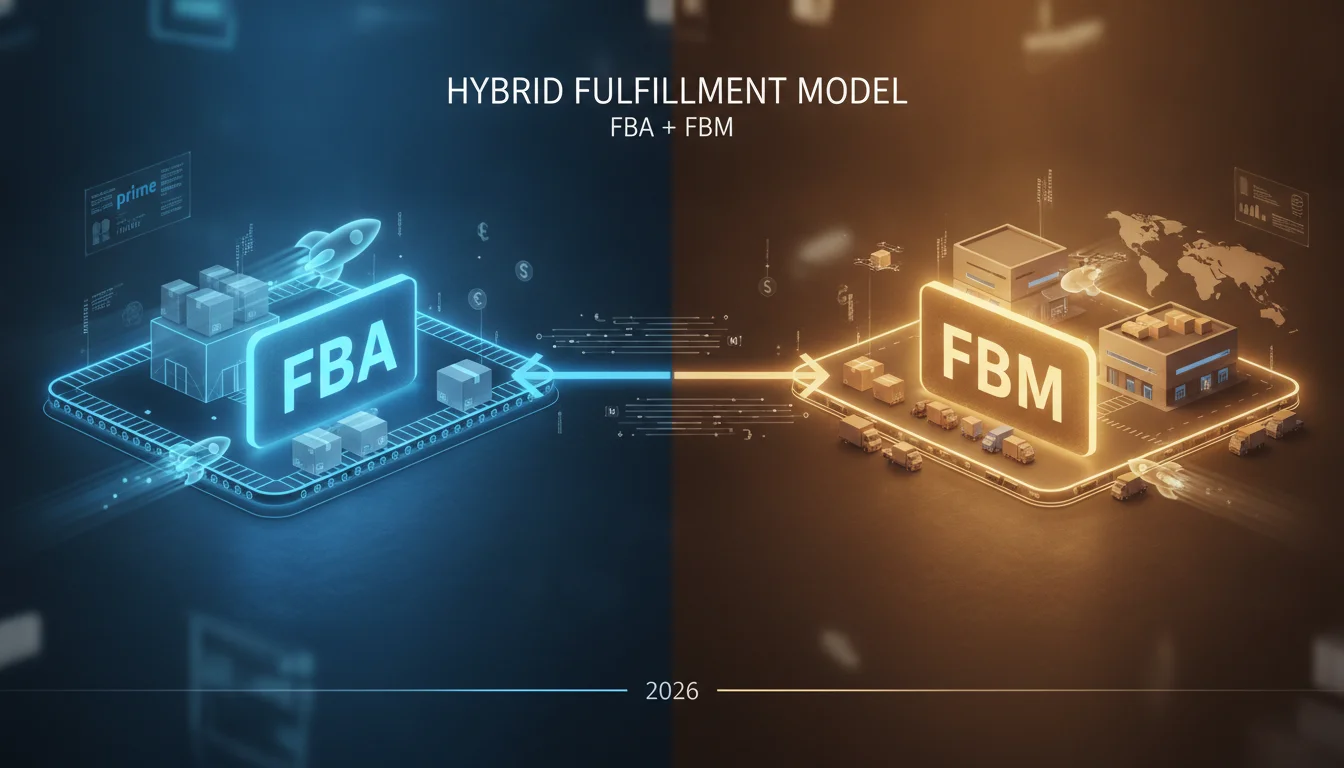
Master the Hybrid FBA FBM Fulfillment Model in 2026: The Definitive Split-Catalog Blueprint
Entering 2026, the economics of Amazon selling have undergone a structural paradigm shift. The era of blindly defaulting to 100% Fulfillment by Amazon (FBA) is officially dead. Between escalating inbound placement service fees, punitive low-inventory-level fees, aggressive long-term storage surcharges, and unpredictably volatile capacity limits, relying exclusively on Amazon’s fulfillment network has turned standard operating margins into paper-thin liabilities.
Savvy brand owners, aggregators, and private label operators are pivoting to the hybrid FBA FBM fulfillment model in 2026. By orchestrating a mathematically sound, split-catalog strategy, high-velocity stock maintains critical Prime badge conversion, while bulky, seasonal, or slow-moving catalog tiers leverage cost-efficient third-party logistics (3PL) infrastructure and Merchant Fulfilled Network (FBM) pipelines.
This exhaustive, research-backed guide breaks down the semantic mechanics, financial architecture, and operational execution required to deploy a dual-fulfillment framework that protects your Buy Box share, stabilizes cash flow, and eliminates catastrophic Amazon logistics bottlenecks.
The Core Economics: Why 100% FBA Fails in 2026
To understand the necessity of a split catalog, we must analyze the compounded fee structures Amazon instituted leading into 2026. When Amazon decentralized its fulfillment network into regional fulfillment centers, it offloaded the cost of inbound national distribution directly onto sellers via Inbound Placement Fees. Simultaneously, the algorithm penalizes accounts whose historical days of supply fall below minimum thresholds through the Low-Inventory-Level Fee.
Sellers are trapped between two expensive extremes: send in too much inventory and suffer devastating aged-inventory surcharges; send in too little, and surrender 3% to 8% of gross product margin in low-stock penalties. The hybrid model acts as a structural circuit breaker against this dynamic.
| Metric / Cost Vector | 100% Pure FBA | 100% Pure FBM | Hybrid FBA + FBM Model (2026) |
|---|---|---|---|
| Inbound Placement Surcharges | High (Paid on all shipments) | None (Shipped direct to 3PL) | Optimized (FBA tier minimized) |
| Low-Inventory Penalties | Persistent Risk | Zero | Virtually Eliminated via FBM Buffer |
| Storage Overhead | Extreme (Amazon cubic-foot fees) | Low to Moderate (3PL pallet rates) | Balanced (Just-In-Time replenishment) |
| Prime Badge / Conversion | 100% Guaranteed | Restricted (Unless SFP approved) | Dynamic (Active on primary SKUs) |
| Buy Box Resilience | Zero if FBA goes out of stock | Competitive against other FBM | 100% (Instant fallback switch) |
Prerequisites: Preparing Your Hybrid Fulfillment Infrastructure
Before modifying catalog architectures within Seller Central, you must establish an operational foundation. Transitioning half-cocked will cause split-SKU buy-box suppressions, late shipment rate (LSR) violations, and account health suspensions.
- An Enterprise Inventory Management System (IMS): Multi-channel inventory software (such as Katana, Cin7, SoStocked, or Sellbrite) capable of routing inventory allocations between Amazon warehouses and off-platform facilities in real-time.
- Vetted 3PL Partner with API Capabilities: A logistics provider that integrates directly with Amazon’s Buy Shipping Services API or supports EDI integrations for same-day order ingestion.
- Automated Shipping Software: Tools like ShipStation, DesktopShipper, or Amazon Seller Central automated shipping templates configured with precise daily order cut-off times.
- Zero-Day Handling Time Capacity: FBM configurations in 2026 demand same-day or next-day transit confirmation to maintain Buy Box parity against Prime offers.
- Precise Product Master Data: Verified weight, cube dimensions, and velocity metrics across your entire catalog, segmented by standard deviation of weekly demand.
Step-by-Step Implementation: The 2026 Split-Catalog Deployment Guide
Follow this exact chronological framework to transition from monolithic FBA to an agile hybrid infrastructure without losing ranking, indexation, or Buy Box ownership.
Step 1: SKU Catalog Segmentation (The Pareto Classification)
Never split your catalog arbitrarily. Execute a comprehensive ABC velocity and dimensional analysis across your active catalog using the trailing 90 days of unit sales and dimensional weight data.
- Tier 1: High Velocity, Compact Dimensions (Pure FBA): Products generating top 20% sales volume with low cubic volume. These sustain high turnover, easily maintain a 30-to-60-day historical inventory supply, and avoid low-inventory penalties naturally. Keep these on FBA to maximize Prime conversion.
- Tier 2: Seasonal, Volatile, or Heavy/Bulky (Pure FBM or Hybrid SFP): Items with erratic demand curves, large package dimensions, or products exceeding 20 pounds. Offload storage to a cost-effective 3PL pallet model. Fulfill directly using regional carrier ground networks.
- Tier 3: The Core Hybrid Buffer (Dual-SKU Listing): Your mid-tier performers. These ASINs generate consistent cash flow but are sensitive to Amazon inbound placement delays or supplier lead-time hiccups. These will exist as both an FBA SKU and an FBM SKU concurrently.
Step 2: Dual-SKU Architecture Creation in Seller Central
Amazon policies explicitly permit offering both an FBA and an FBM option for the same ASIN, provided you do not duplicate the catalog listing itself. You are creating multiple fulfillment offerings under a singular Parent/Child ASIN structure.
- Navigate to Seller Central > Inventory > Manage All Inventory.
- Locate the target ASIN currently running on FBA.
- Click the drop-down menu on the far right and select Add Another Condition.
- Configure the new offering with precise SKU nomenclature conventions:
- Set the new SKU to:
[OriginalSKU]-FBM(e.g.,HYB-WIDGET-01-FBM). - Keep the original SKU as:
[OriginalSKU]-FBA(e.g.,HYB-WIDGET-01-FBA).
- Set the new SKU to:
- Set the condition to New and set standard pricing identical to your FBA offer.
- Under fulfillment channel, select: I will ship this item myself (Merchant Fulfilled).
- Save and finish. The system will create an FBM SKU mapped to the identical ASIN within 15 minutes.
Step 3: Configuring Regional Merchant Shipping Templates
Your FBM SKU must perform closely to Prime standards to remain viable when FBA stock depletes. Standard nationwide shipping templates with 3-5 day transit lead times will result in catastrophic conversion drops. Configure automated regional shipping templates instead.
- Go to Settings > Shipping Settings > Shipping Templates and click Create New Template.
- Enable Shipping Settings Automation (SSA). This allows Amazon to dynamically calculate accurate transit times based on your shipping warehouse zip code and selected carrier services.
- Select your warehouse carriers (e.g., UPS Ground, FedEx Home Delivery, USPS Ground Advantage).
- Set zero-day handling time for orders placed before your carrier cut-off time (typically 2:00 PM local time).
- Assign your newly generated
*-FBMSKUs strictly to this optimized template.
Step 4: Algorithmic Price and Buy Box Parity Configuration
The primary concern when operating dual SKUs is avoiding self-competition or accidentally winning the Buy Box with the FBM offer when FBA stock is available, which lowers overall conversion. You must build an intentional margin buffer.
Configure your automated repricer (such as BQool, Feedonomics, or Seller Snap) using condition-based logic:
- Scenario A (FBA In Stock): Price the FBA SKU at your primary retail target price ($29.99). Price the FBM SKU slightly higher ($31.49) or match the price with shipping fees baked in. This forces the Amazon A9/Cosmo algorithm to award the Buy Box to your FBA offer due to fast Prime fulfillment.
- Scenario B (FBA Depleted / Inbound Receiving): The moment FBA inventory hits zero, your FBA listing drops off the Buy Box. Amazon immediately switches the Buy Box to your secondary
*-FBMSKU without a single second of catalog downtime. - Scenario C (Price Parity Fallback): Adjust the FBM price dynamically downward to match standard retail the second FBA stock zeroes out, preventing price-gouging algorithm flags while protecting conversion.
Step 5: Establishing the Inbound JIT (Just-In-Time) Supply Loop
Rather than sending 90-day bulk container shipments into Amazon Fulfillment Centers, divert ocean containers or domestic freight to your private 3PL warehouse. From there, initiate small, frequent, consolidated LTL or SPD shipments to Amazon fulfillment centers on a rolling 14-day cycle.
This guarantees two critical operational results: First, your low-inventory fees remain at zero because your rolling pipeline is backed by a continuous in-stock signal. Second, your FBM SKU serves as live, deliverable inventory available on the listing even while Amazon processes inbound FBA shipments through extensive cross-dock sorting delays.
Troubleshooting Common Hybrid Model Failures
Even veteran operations teams hit structural roadblocks when scaling dual-fulfillment architecture. Here is how to diagnose and correct the most frequent failure points.
1. The FBM SKU Accidentally Steals the Buy Box from Your FBA SKU
Cause: If your FBM SKU is priced lower than FBA, or if your local customer is geographically adjacent to your 3PL warehouse and Amazon calculates faster local next-day delivery via Merchant shipping, the algorithm may favor the FBM offer.
Solution: Apply automated repricing rules that tie the FBM floor price strictly to +2% to +4% over the FBA listing price whenever FBA units exceed minimum safety stock thresholds.
2. Late Shipment Rate (LSR) and Valid Tracking Rate (VTR) Spikes
Cause: Sudden stock-outs at your off-Amazon 3PL or delays in tracking number synchronization over weekends will quickly trigger Account Health notifications.
Solution: Set an automated “phantom inventory cap” inside your inventory management software. If your 3PL shows 100 units on hand, pass only 70 units to Amazon via the FBM listing. That 30% reserve prevents stockouts from order synchronization latency. Always purchase shipping labels directly through Amazon’s Buy Shipping API to guarantee 100% VTR compliance and protect against A-to-z claim delivery strikes.
3. Stranded Inventory or Suppressed ASIN Errors
Cause: Inadvertently changing the fulfillment channel on an existing SKU instead of creating a unique secondary SKU condition. This breaks inbound shipments and strands FBA pallets mid-transit.
Solution: Never click “Change to Fulfilled by Merchant” on an existing FBA listing. Always keep the FBA SKU isolated, and use the “Add Another Condition” process to generate an independent Merchant Fulfilled SKU.
Real-World Case Study: Omnichannel Scale in Practice
Consider an enterprise kitchenware brand managing 120 SKUs on Amazon US, generating $4.2 million in annual gross revenue. In early 2025, the brand faced severe margin degradation: Inbound Placement Fees cost an average of $0.34 per unit, while unpredictable seasonal spikes in cast-iron skillets caused sudden stock-outs, triggering Low-Inventory-Level surcharges on subsequent restocks.
The Strategic Pivot
- The brand identified 25 high-velocity, lightweight items (silicone utensils, measuring spoons) and retained them on 100% FBA.
- They isolated 15 heavy, low-margin products (cast-iron Dutch ovens, large butcher blocks) and shifted them to 100% FBM fulfilled via an Ohio-based 3PL using regional ground carrier contracts.
- The remaining 80 mid-tier SKUs were converted to the Hybrid FBA + FBM dual-condition framework.
The Results Over 12 Months
- Storage and Placement Fee Reductions: Off-Amazon bulk pallet storage dropped overhead costs by 42% compared to standard Amazon peak-storage brackets.
- Zero Out-of-Stock Downtime: During Q4 peak, three core SKUs ran out of FBA inventory due to unexpected port delays. The FBM SKU instantly captured the Buy Box, preserving $180,000 in revenue that would have otherwise defaulted to competitors.
- Net Margin Expansion: Overall operating margin increased by 4.8% net across the entire portfolio, while maintaining an account-wide Buy Box win rate of 96.2%.
Frequently Asked Questions (FAQ)
Can I get banned for having both an FBA and FBM listing on the same ASIN?
No. Amazon’s official Business Solutions Agreement and listing policies explicitly allow dual fulfillment offers (one FBA and one FBM) under the same ASIN, provided both represent the identical physical item, condition, and UPC. You may not, however, create duplicate FBM listings for the exact same ASIN to manipulate search visibility.
Does having an active FBM SKU hurt my FBA SKU’s organic ranking?
No. Organic rank is tied directly to the ASIN’s historical sales velocity, click-through rate (CTR), and conversion rate. In fact, the hybrid model protects organic ranking: when an FBA-only listing goes out of stock, its sales velocity drops to absolute zero, causing its organic keyword positions to plummet. An active FBM safety net keeps units moving and maintains continuous conversion history for the algorithm.
What is the ideal inventory split ratio between FBA and FBM?
For most mid-to-high velocity brands in 2026, the optimal operational split is the 30/70 inventory distribution rule. Keep approximately 30 to 45 days of supply inside Amazon’s fulfillment centers to maintain Prime conversion and avoid low-inventory penalties. Hold the remaining 60 to 75 days of reserve inventory in your off-Amazon 3PL warehouse to feed continuous FBA replenishment while backing the live FBM SKU.
Can I offer Prime shipping on my FBM SKUs?
Yes, through Amazon’s Seller-Fulfilled Prime (SFP) program, provided your account meets strict performance criteria: 99%+ on-time shipping, nationwide 1-to-2 day delivery coverage on standard-sized items, and direct utilization of Amazon Buy Shipping. If you cannot meet SFP metrics, regular automated FBM templates still offer competitive conversion when FBA runs out.
How do I prevent my automated repricer from causing a price war with myself?
You must use an enterprise repricing tool with distinct multi-condition parameters. Set rules that explicitly designate your FBA SKU as the primary listing and instruct your FBM SKU to “Match FBA Price + $1.50” or maintain a passive status until the FBA inventory quantity reaches zero.
Conclusion: Future-Proofing Your Fulfillment Strategy
Amazon’s logistics roadmap is transparent: the platform will continue decentralizing operational costs, pushing inventory holding liability and staging expenses onto marketplace sellers. Treating Amazon as an all-in-one warehousing, fulfillment, and logistics provider is no longer financially viable for scaling businesses.
Deploying a hybrid FBA FBM fulfillment model in 2026 transforms logistics from a defensive cost center into an offensive competitive moat. By retaining Prime conversion velocity on your best-sellers, drastically reducing Amazon storage overhead via 3PL partnerships, and eliminating stockout ranking penalties with merchant backups, you protect your bottom line against platform volatility.
Audit your catalog today. Run the velocity and dimensional segmentation, build your dual-SKU structure, and insulate your business from Amazon’s fee matrix before the next fee restructuring cycle cuts into your profits.

Add comment