
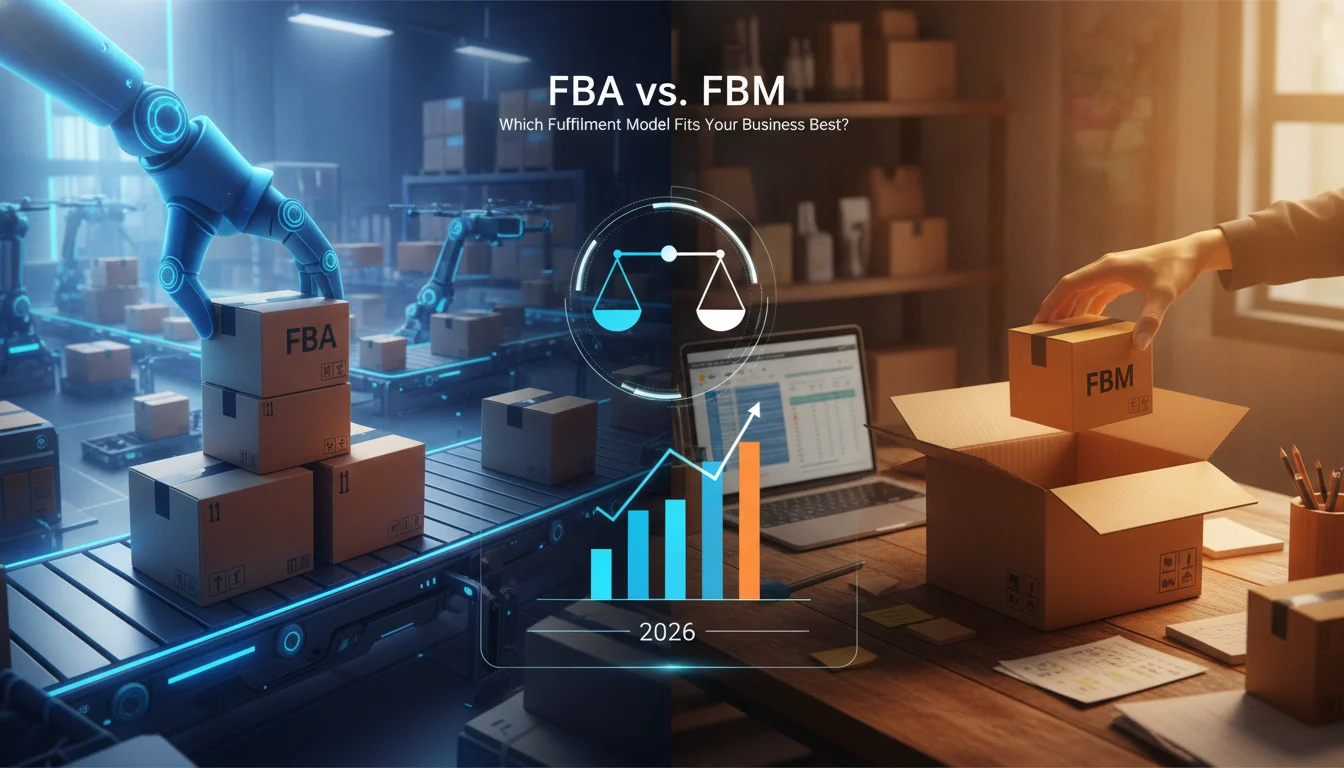
FBA vs. FBM in 2026: Which Fulfillment Model Fits Your Business Best?
Selling on Amazon in 2026 demands far more operational agility than it did even two years ago. With Amazon’s revamped fee architectures including refined inbound placement fees, regional inventory distribution mandates, and rising storage penalties choosing between Fulfillment by Amazon (FBA) and Fulfillment by Merchant (FBM) is no longer a simple question of convenience versus control. It is a critical financial decision that dictates your unit economics, inventory turnover, and capacity to scale.
Whether you are launching your first private-label product or managing an eight-figure omnichannel catalog, this guide breaks down the true operational costs, structural trade-offs, and bottom-line impacts of FBA versus FBM in 2026.
Key Takeaways:
- FBA remains the conversion powerhouse: Automatic Prime badge eligibility, superior Buy Box win rates, and hands-off customer service provide undeniable sales velocity, particularly for standard-size, high-margin SKUs.
- FBA cost structures require rigorous margin protection: Complex fee layers—such as inbound placement fees and low-inventory-level fees penalize poor supply chain forecasting more heavily than ever.
- FBM offers critical margin preservation for heavy/oversized goods: Sellers with existing third-party logistics (3PL) infrastructure, custom products, or bulky items gain better unit margins and retain total control over customer data.
- The hybrid model is the new standard: Top-performing brands in 2026 increasingly use FBA for their top 20% velocity drivers and FBM for long-tail, hazmat, or oversized inventory to hedge against stockouts and rising Amazon storage fees.
The 2026 Decision Framework: How to Evaluate Your Catalog
Before examining individual fee schedules, evaluate your business against four operational pillars. Each pillar directly determines which fulfillment path yields the highest return on investment.
1. Product Dimensions and Weight Tiers
Amazon’s automated fulfillment centers are optimized for high-density, lightweight, uniform items. Standard-size products under 2 pounds generally achieve the best cost efficiency under FBA. Conversely, large, bulky, or irregular goods trigger steep size-tier surcharges and dimensional weight calculations that make merchant fulfillment or specialized 3PLs far more cost-effective.
2. Velocity, Inventory Turns, and Restock Reliability
Amazon severely penalizes sluggish inventory while concurrently penalizing stockouts. If your supply chain experiences sporadic lead times or inconsistent demand spikes, FBA’s inventory-level fees can quickly drain gross margins. Predictable, fast-turning products thrive in FBA; volatile or long-tail products run more safely through FBM.
3. Margin Buffers and Unit Economics
Calculate your Net Margin after accounting for Amazon’s referral fee, fulfillment fee, and shipping. If your gross margin is below 30%, layered FBA fees leave virtually no room for marketing ad spend (PPC) or seasonal price reductions. FBM lets you negotiate custom carrier rates or optimize packaging to safeguard thin margins.
4. Brand Experience and Multi-Channel Synergies
FBA packs your products in generic, Amazon-branded tape and cardboard, limiting your post-purchase branding options. If your business relies on branded packaging, marketing inserts, custom kitting, or ships across multiple channels (Shopify, TikTok Shop, eBay), FBM powered by an independent 3PL avoids Amazon’s costly Multi-Channel Fulfillment (MCF) markups.
Side-by-Side Comparison: FBA vs. FBM in 2026
Here is how the two models compare across core operational metrics:
| Evaluation Metric | Fulfillment by Amazon (FBA) | Fulfillment by Merchant (FBM) |
|---|---|---|
| Prime Badge Eligibility | Automatic across all eligible inventory. | Requires qualification for Seller Fulfilled Prime (SFP) with strict delivery SLAs. |
| Buy Box Competitiveness | Highest algorithmic weight; natural advantage on competitive listings. | Requires lower landed price or flawless metrics to beat competitive FBA offers. |
| Fee Predictability | Complex; subject to placement, handling, peak, and low-stock fees. | High; relies on straightforward carrier contracts and fixed warehouse costs. |
| Inventory Control | Strict restock limits, aged inventory surcharges, and placement rules. | Full control over warehouse distribution, inspection, and inventory hold times. |
| Customer Service & Returns | Amazon handles 24/7 support and buyer returns; automated return processing. | Merchant manages all buyer inquiries, claims, replacements, and reverse logistics. |
| Packaging & Branding | Amazon standard packaging; strictly limited custom inserts. | 100% customizable packaging, inserts, flyers, and branded presentation. |
| Best Suited For | Lightweight, fast-turning items, private label, hands-off sellers. | Oversized products, fragile goods, B2B orders, personalized or custom items. |
Honest Trade-offs: Where Each Model Excels and Struggles
Choosing a fulfillment strategy involves accepting clear operational trade-offs. Here is an unvarnished look at where each model delivers results and where it introduces friction.
The Realities of FBA: Velocity vs. Margin Erosion
The primary reason sellers commit to FBA is conversion velocity. Amazon shoppers trust the Prime badge, expect guaranteed one- or two-day transit windows, and convert at nearly double the rate of non-Prime listings. FBA sellers delegate the headaches of warehousing, late delivery metrics, and routine customer queries directly to Amazon’s logistics network.
However, the operational complexities in 2026 are significant:
- Layered Logistics Costs: Beyond base pick-and-pack rates, sellers navigate inbound placement service fees (incurred unless splitting shipments across multiple regional hubs yourself), aged inventory fees starting as early as 180 days, and low-inventory-level penalties.
- Unforgiving Return Policies: Because Amazon handles returns autonomously, return rates under FBA are historically higher than FBM. Items marked by buyers as “defective” are frequently relegated to unfulfillable status, requiring removal orders or forced liquidation.
- Capital Tied to Amazon’s Timeline: Inbound check-in times during peak Q4 sales can stretch up to three weeks, during which your inventory remains unavailable for purchase while your advertising momentum stalls.
The Realities of FBM: Ultimate Control vs. Operational Rigor
FBM puts operational destiny back into your hands. You maintain direct custody of your inventory, meaning you can pivot shipments across wholesale accounts, retail stores, or alternative digital marketplaces without paying Amazon expensive inventory disposal or return fees.
Yet FBM is not a simple shortcut to higher profits:
- Operational Discipline: To win and maintain the Buy Box without FBA, your late shipment rate must stay strictly under 1%, your valid tracking rate above 95%, and your pre-fulfillment cancellation rate under 0.5%. A sudden surge in sales during a holiday weekend can jeopardize account health if staff cannot fulfill orders on time.
- Carrier Volatility: Unless your volume commands substantial tier-1 carrier discounts with FedEx, UPS, or USPS, individual parcel shipping costs can surpass Amazon’s discounted bulk-rate fulfillment fees.
- Customer Service Overhead: You must field all inquiries, “where is my order” messages, and return claims. Failing to respond within Amazon’s 24-hour SLA directly threatens your seller rating.
Strategic Breakdown: Which Model Fits Your Business Profile?
Persona A: The Private-Label Brand Builder
Verdict: Primarily FBA
If you manufacture lightweight, uniform products under your own brand, the conversion benefits of the Prime badge are indispensable. The competitive advantage in search rank and consumer trust vastly outweighs the incremental fulfillment fees. Focus your resources on continuous inbound forecasting to maintain optimal 30-to-60-day stock cover and avoid low-inventory or long-term storage penalties.
Persona B: The Oversized, Bulky, or Industrial Seller
Verdict: Dedicated FBM (via specialized 3PL)
Sellers offering furniture, fitness equipment, automotive components, or commercial supplies should avoid FBA. Amazon’s cubic-foot storage rates and heavy-item handling fees disproportionately degrade operating margins. By leveraging an independent 3PL that specializes in freight and oversized parcels, you preserve your margins while packaging items securely to minimize transit damage.
Persona C: The High-SKU Reseller or Dropshipper
Verdict: Hybrid FBM with Selective FBA
Managing hundreds of SKUs with uncertain demand makes FBA an expensive liability. List your broad catalog as FBM to test market interest without incurring inbound shipping and storage expenses. Once a specific SKU proves steady, daily velocity, migrate that specific product into FBA to capture the Prime lift.
The Winning Play for 2026: Building an Adaptive Hybrid Strategy
Sophisticated e-commerce operators rarely view FBA and FBM as an either-or decision. In 2026, the dominant fulfillment strategy is hybrid integration.
By establishing dual fulfillment listings (creating an FBM offer as a backup to your primary FBA SKU), you construct an operational safety net:
- Eliminate Stockout Penalties: If your inbound inventory gets delayed at an Amazon fulfillment center, your listing automatically switches to your FBM offer. This preserves your organic keyword rankings and keeps cash flow uninterrupted.
- Optimize Inbound Placement Economics: Ship bulk inventory to an affordable regional consolidation warehouse. From there, send smaller, predictable weekly replenishment batches to Amazon to satisfy local fulfillment requirements while avoiding steep inbound fees.
- Capture Regional Demand Fluctuations: Deploy FBM for regions where Amazon fulfillment hubs face extended delays or during extreme seasonal volume peaks when Amazon limits intake capacity.
Final Assessment
Choosing between FBA and FBM in 2026 comes down to matching your operational capability with product characteristics. Choose FBA if your products are compact, high-margin, and require aggressive conversion acceleration to compete in crowded search spaces. Turn to FBM if your catalog features high dimensional weight, custom kitting, or thin unit margins that cannot absorb unpredictable storage fees.
Audit your catalog SKU by SKU. Run your numbers through Amazon’s updated Revenue Calculator with current inbound freight and placement fees factored in. The most profitable choice is rarely ideological it is the one that protects your contribution margin on every single shipment.


Add comment